
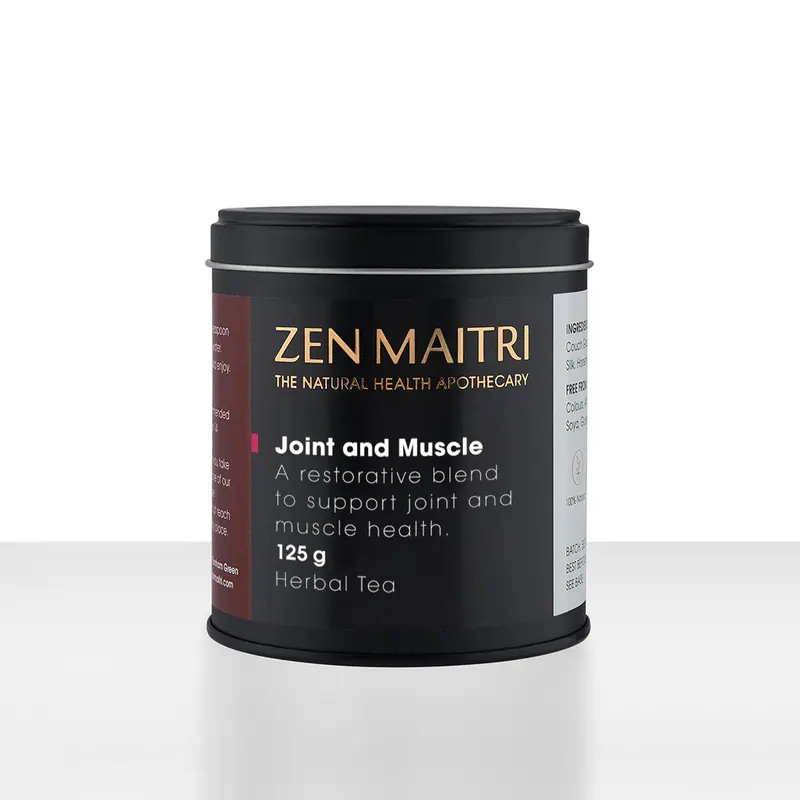

A loose-leaf herbal blend with meadowsweet, turmeric, ginger, cinnamon, nettle and Solomon’s seal root.
Modulating Tissue Irritation, Calming Localized Discomfort & Natural Salicin Chemistry
To effectively support mobility and ease physical tension, traditional herbal medicine utilizes anti-inflammatory botanicals that help modulate inflammatory cascades and tissue irritation. Rather than overriding the body’s natural warning signs, these plants work mechanically to support healthy blood flow, protect cellular health, and maintain long-term joint health.
Filipendula ulmaria (Meadowsweet) has a long history of use in traditional herbal medicine as a primary remedy for joint irritation, localized stiffness, and muscular discomfort. It contains natural salicylic glycosides—the plant compounds from which modern aspirin was originally derived. These constituents provide gentle comforting and anti-inflammatory support directly to aching joints and tight muscles. Additionally, Meadowsweet is rich in natural tannins and silica, which support the body’s natural clearance of metabolic waste accumulations from joints while adding a pleasant aroma to the infusion.
Curcuma longa (Turmeric Root) is a highly valued botanical antioxidant that helps modulate inflammation throughout the musculoskeletal system. Its active constituents work to manage oxidative stress, easing stiffness and supporting recovery after physical activity. Beyond its benefits for muscle and joint health, Turmeric acts as a natural digestive aid, supporting the efficient assimilation of nutrients and proteins required for healthy muscle repair.
Circulatory Stimulation, Oxygenation & Fluid Dynamics
Sustained joint health and muscle recovery relies on efficient peripheral circulation to deliver oxygenated blood and essential nutrients to poorly vascularised connective tissues like ligaments and tendons.
Zingiber officinale (Ginger Root) is a classic warming circulatory stimulant traditionally used to support blood flow to the extremities. By expanding peripheral blood vessels, Ginger supports an increase in the delivery of oxygen and nutrients to tight muscles and strained joints, helping to speed up tissue recovery and ease tension in the muscles and joints. It also helps settle localized discomfort and aches.
Cinnamomum verum (Cinnamon Bark) works alongside Ginger to support peripheral circulation and support the body’s natural clearance of metabolic stagnation. Its natural antioxidants help ease tissue tension, relax tight muscles, and ease physical fatigue after exertion.
Mineralisation, Connective Tissue Integrity & Metabolic Clearance
Long-term mobility requires a steady supply of structural building blocks to maintain healthy cartilage, bones, and ligaments, alongside efficient clearance pathways for cellular waste.
Urtica dioica (Nettle Leaf) provides an earthy base and a rich profile of essential minerals, including silica, calcium, magnesium, iron, and potassium. These nutrients contribute to maintaining the structural integrity of bones, joints, and ligaments. Nettle also acts as a gentle, non-irritating diuretic, supporting liver and kidney filtration to help clear metabolic byproducts through the urine, which helps ease fluid retention and stiffness around the joints.
Polygonatum odoratum (Solomon’s Seal Root) is a specialized musculoskeletal botanical traditionally used to support connective tissues. It helps maintain the natural elasticity and tone of ligaments and tendons, supporting joint alignment and resilience during recovery from strains or heavy physical demand.
Clinical Validation & Scientific Studies
At Zen Maitri, our traditional formulations are continually reviewed alongside modern research to ensure our functional blends meet the highest standards of contemporary wellness. Below is the peer-reviewed clinical study supporting the traditional applications of the core botanicals found in this blend:
Management of Muscle Discomfort & Recovery (Zingiber officinale): A randomized, double-blind, placebo-controlled trial found that daily ginger supplementation significantly reduced exercise-induced muscle pain following eccentric exercise. These effects are thought to relate, in part, to the anti-inflammatory properties of ginger constituents, including their modulation of cyclooxygenase (COX) and lipoxygenase (LOX) pathways.
Reference: Black, C. D., et al. (2010). Ginger (Zingiber officinale) Reduces Muscle Pain Caused by Eccentric Exercise. The Journal of Pain, 11(9), 894-903.
Reviews
There are no reviews yet.