
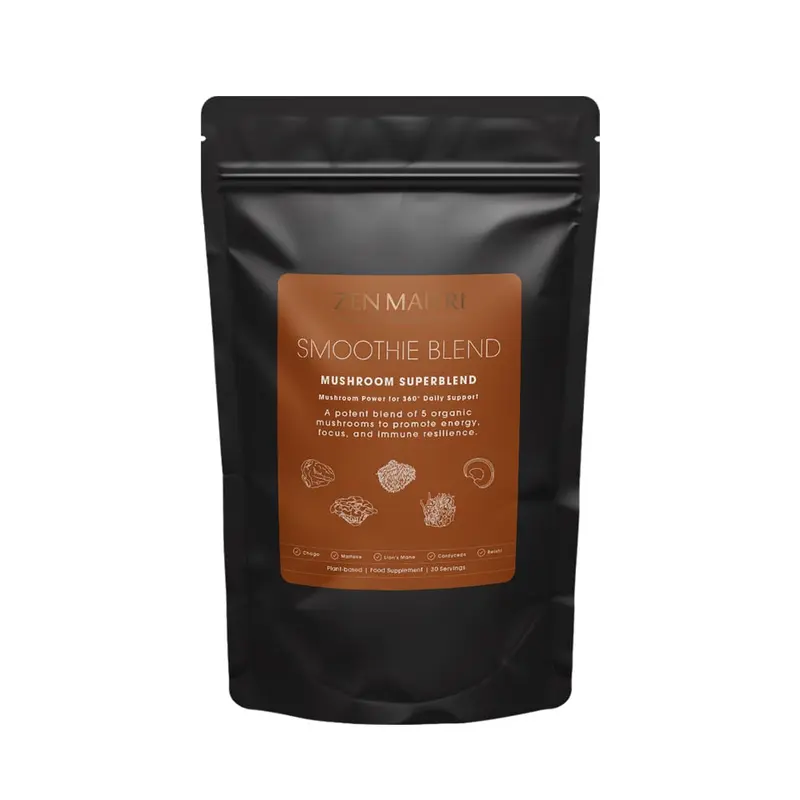

Whole Mushrooms and Their Compounds
Functional mushrooms have long been welcomed into daily routines across many cultures. Each of these whole mushrooms naturally contains compounds, including beta-glucans and other polysaccharides, retained by using the whole mushroom rather than an isolated extract, and these compounds are an active area of nutritional research.
Adaptogens and Fungal Compounds
Several of these species are traditionally described as adaptogens, a recognised category of botanicals with a long history of traditional use. The blend naturally contains polysaccharides, including beta-glucans, within the mushrooms’ cell walls; these are a continuing subject of scientific research.
Grounded Traditions Meet Easy Preparation
For generations, mushrooms have featured in traditional food and wellbeing practices around the world. To honour that heritage while applying modern manufacturing standards, the mushrooms are gently milled rather than concentrated through extraction, finely disrupting the cell material while retaining the naturally occurring compounds of the whole mushroom.
Traditional Frameworks & Mycological Profiles
These mushrooms have a long history of traditional use, particularly across Asian food and wellbeing traditions, where different species have been valued as nourishing and restorative ingredients. Each is described above with its tradition and the research into its naturally occurring compounds.
Historically, these specific whole mushrooms have been traditionally used for:
Lion’s Mane & Brain Health (Hericium erinaceus): Lion’s Mane has a long history of traditional use and is increasingly studied for its potential role in cognitive and neurological health. Research has investigated naturally occurring compounds in Lion’s Mane for their effects on neurotrophic pathways, including those involving Nerve Growth Factor (NGF) and Brain-Derived Neurotrophic Factor (BDNF). Our Lion’s Mane powder provides a convenient way to incorporate this distinctive mushroom into your daily wellness routine.
Chaga & Cellular Protection (Inonotus obliquus): Chaga has a long history of traditional use, particularly in northern Eurasian folk medicine, where it has traditionally been prepared as a tea or decoction. Modern research has identified a range of naturally occurring compounds in Chaga, including polyphenols, triterpenoids and polysaccharides, many of which have demonstrated antioxidant activity in laboratory research. Chaga has also been traditionally used in connection with digestive wellbeing. Our Chaga powder provides a simple way to incorporate this distinctive mushroom and its naturally occurring compounds into your everyday wellness routine.
Cordyceps & Physical Stamina (Cordyceps sinensis): Cordyceps has a long history of use in traditional Chinese medicine, where it has traditionally been valued in connection with lung and kidney wellbeing, vitality and physical stamina. Modern research is investigating Cordyceps for its potential effects on exercise performance, respiratory function and other aspects of physical wellbeing.
Reishi & Nervous System Balance (Ganoderma lucidum): Long valued in traditional Chinese medicine, Reishi has been traditionally used as a nourishing tonic associated with calm, vitality and general wellbeing. Modern research is exploring Reishi’s naturally occurring polysaccharides and triterpenes, including their potential roles in immune and inflammatory pathways. Preliminary human research has also investigated Reishi preparations in relation to fatigue and wellbeing.
Maitake & Metabolic Health (Grifola frondosa): Known in Japanese as “Maitake,” meaning “dancing mushroom,” this distinctive mushroom has a long history of traditional use in Japan and China, where it has been valued as a nourishing food and traditional wellness ingredient. Modern research has focused on Maitake’s naturally occurring polysaccharides and other compounds, particularly their potential roles in immune and metabolic pathways. Preliminary research has also investigated Maitake in relation to glucose metabolism, although further human research is needed to establish its effects.
.
|
Active Ingredient |
Part Used |
Processing Type |
Quantity Per Serving (5g) |
|
Certified Organic Chaga |
Mycelium (Root Network) |
1:1 Whole Shell-Broken Powder |
1,000 mg |
|
Certified Organic Maitake |
Fruit Body (Mushroom Cap) |
1:1 Whole Shell-Broken Powder |
1,000 mg |
|
Certified Organic Lion’s Mane |
Fruit Body (Mushroom Cap) |
1:1 Whole Shell-Broken Powder |
1,000 mg |
|
Certified Organic Cordyceps |
Mycelium (Root Network) |
1:1 Whole Shell-Broken Powder |
1,000 mg |
|
Certified Organic Reishi |
Fruit Body (Mushroom Cap) |
1:1 Whole Shell-Broken Powder |
1,000 mg |
Reviews
There are no reviews yet.